How We Keep Acetate Hair Claw Clips Consistent in Bulk Production
November 19, 2026
Pick up two hair claws from the same order and close both. If one closes with the teeth sitting slightly to the side, you’ll spot it straight away. If one takes noticeably more pressure to open, you’ll feel that before you see anything unusual. These are the details we pay attention to when we take an approved cellulose acetate hair claw clip into bulk production.
We’re Yiwu Glory Hair Accessories Co., Ltd., an OEM and ODM manufacturer founded in Yiwu, China, in 2015. We develop and produce cellulose acetate hair claws, barrettes and combs for brands and wholesale buyers. At our Yiwu factory, claw clips go from CNC cutting and forming to assembly and final inspection before packing. The workshop photos in this article show how our team shapes the acetate before fitting the spring.
A good sample gives the buyer and the factory something they can both point to. At Glory Hair Accessories, we use it as a reference for how the clip should look from the side, how the teeth should meet and how the spring should feel. Two clips in the same tortoiseshell colour can have different swirls because their pieces were cut from different parts of the sheet. The shape and fit still need to match what the buyer approved.
Where the shape comes from
A claw clip is made from two shaped halves joined at the hinge. Each half has its own curve, and a small difference between those curves can show up as a wider gap at one end once the clip is closed. That’s why we pay attention to the shape during forming, before the clip reaches assembly.
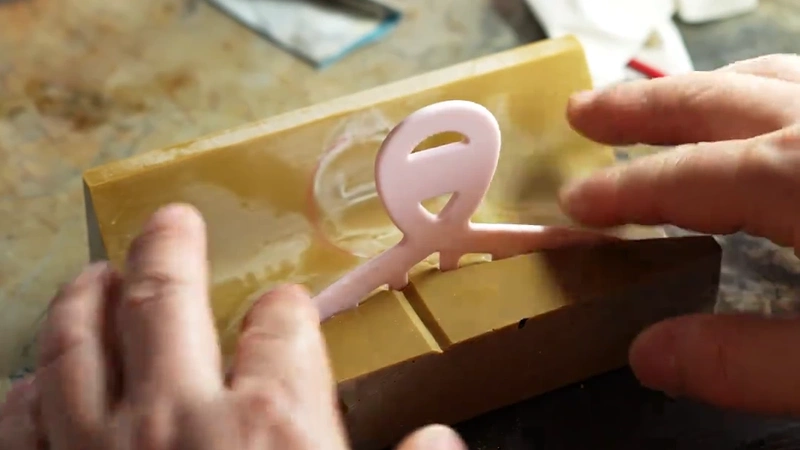
The cover photo shows a worker positioning a pale pink acetate claw clip half in a forming jig. The jig supports the body of the piece at the curve needed for that design. The curve needs to be right for that particular model. A shallow mini claw and a long claw that wraps around a thicker section of hair have different profiles, even if both are made from the same acetate sheet.
From forming to assembly

Shaping a pink acetate claw clip half in a handheld mould | The press head lowered onto the forming die
These workshop photos show two views of the shaping stage. The worker positions the piece in the tool, then the formed part can be compared with the approved profile. The tool helps repeat the curve as the same style moves through production. The assembled clip is where we see how well the two halves fit together.
What we look at when the clip closes
We look at the closed clip from the front and from the side. Check the ends first. A gap that looks even at the hinge can open up towards a tip. Then look at the teeth. On an interlocking design, each tooth should sit where it does on the approved sample, with enough clearance to pass the opposite row. Some designs have a visible gap when closed, so we judge the gap against the approved shape for that model.
Then we open and close the clip by hand. Sometimes the fit looks fine on the bench and there’s still a catch partway through opening. Sometimes the hinge moves smoothly but the spring feels unusually stiff. A side-by-side comparison with the sample helps us tell whether that feel is part of the design. These are functional checks we make before packing.
Spring choice on longer claws
A 13 cm claw for thick hair is a good example of why we discuss the spring during sampling. A buyer may want more hold through a fuller section of hair, while the person using the clip still needs to open it comfortably with one hand. The shape and depth of the clip matter alongside the spring. Try the sample on the hair type the product is being designed for and pay attention to the pressure needed to open it.
For claws around 12 cm and above, we can evaluate a double-spring option if the design is suitable. If you’re deciding between spring options, it helps to try them on the same clip design. Tell us how it feels in use. “The grip is good, but I’d like it easier to open” gives us a clearer direction for the next sample than “please make it stronger.”
What to confirm before approving a sample
Close the clip and take a look at it from both ends. Then use it the way a customer would. Try opening it with one hand and clipping it over the amount of hair it’s intended to hold. If the rounded tips, opening feel or way the teeth meet is important to the design, include that in the approval comments. A close-up photo or a short written note can show us exactly which detail you mean.
If you’re ordering the same model in several colours, you can also confirm the pattern and finish separately from the clip’s function. For example, agree on the overall look of the tortoiseshell before production, while using one approved clip as the reference for how the shape and spring should feel.
If you’re building a private-label range, we can also discuss custom colours, logos and retail packaging while you review the sample. That’s a good time to confirm how the clip should look and feel before the order goes into production.
Planning a wholesale or private-label order? Browse our cellulose acetate hair claw clips. Send us a reference photo or model number, your preferred length and estimated quantity per style and colour. If you have a particular grip or opening feel in mind, tell us what you’d like to achieve. Get a quote from Glory Hair Accessories.