How Can Global Brands Source Directly From Hair Accessories Factories?
September 25, 2026
Global brands can source directly from hair accessories factories by defining the product brief, verifying material and production capability, developing samples, confirming quality standards, and establishing a repeatable ordering process. For acetate products, direct sourcing also requires attention to sheet material, color consistency, pattern depth, edge finishing, polishing, hardware assembly, packaging, and batch traceability. This matters because acetate hair accessories involve more than simple molding. Cellulose acetate is a material derived from cellulose, commonly sourced from wood pulp or cotton, and its processing characteristics differ from conventional plastics.
For a global brand, the factory relationship should therefore start before the first bulk order. A clear technical brief helps the factory understand the required shape, dimensions, material, finish, color, logo treatment, packaging, and target quantity. The buyer can then compare sample quality and production capability before committing to a larger program.
Direct sourcing also changes how buyers manage development. Instead of selecting finished stock from a trading catalog, the brand can work with a factory on custom shapes, material options, colors, finishes, and packaging. This approach can support private-label programs and seasonal collections.
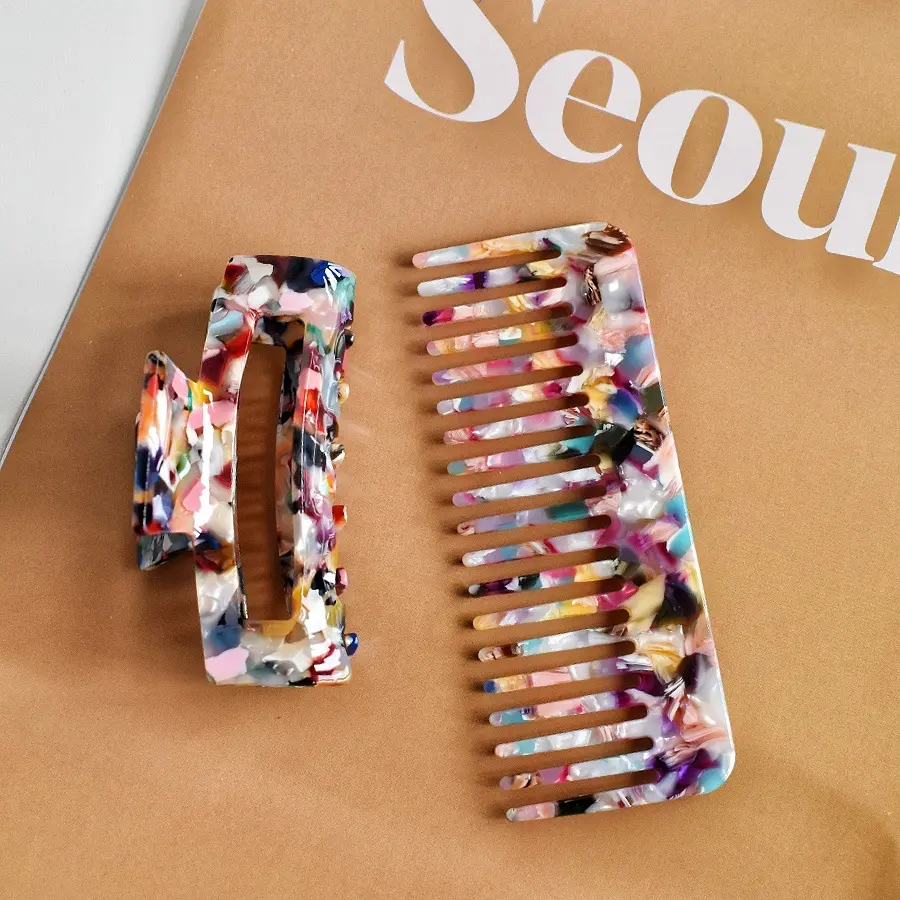
Why Are Acetate Hair Accessories Different From Standard Hair Products?
Acetate accessories require a more controlled material and finishing process than many conventional plastic hair products. The term “acetate” can refer to different materials and constructions, so buyers should confirm the exact material specification with the supplier.
Cellulose acetate is made from cellulose and acetic acid. Commercial cellulose acetate can appear in flakes, pellets, sheets, and other forms depending on the application. DAICEL describes cellulose acetate as a material derived from cellulose obtained from wood pulp or cotton. It also notes applications across films, molded parts, fibers, and coatings.
This material background matters when sourcing hair accessories. A brand requesting a specific acetate look may actually require a particular sheet structure, color formulation, thickness, or finishing process.
Material is only the starting point
For hair clips, headbands, barrettes, claw clips, and combs, the final appearance depends on several production stages.
The material affects:
- Color depth and translucency
- Surface appearance
- Cutting behavior
- Edge quality
- Polishing response
- Thickness consistency
- Resistance to everyday handling
- Compatibility with hardware
A supplier should explain which parts of the product come from the acetate sheet and which parts require additional components.
For example, a claw clip may combine an acetate body with a metal spring and connecting hardware. A barrette may require an acetate plate, metal clasp, decorative elements, and packaging.
The buyer therefore needs to evaluate the complete product rather than judging the acetate sheet alone.
Why cellulose acetate attracts brand attention
Cellulose acetate has also gained attention because its feedstock can originate from plant-based cellulose. DAICEL states that cellulose acetate uses wood-derived or cotton-derived cellulose as a raw material.
However, brands should avoid treating “acetate” as an automatic sustainability claim. Material origin, additives, manufacturing conditions, certifications, and end-of-life behavior all require separate verification.
That distinction is particularly important for global brands. Marketing claims should match the actual material documentation supplied by the manufacturer.
What Should Global Brands Check Before Choosing a Hair Accessories Factory?
A factory should be evaluated through both product samples and production capability. A good-looking sample does not automatically prove that the factory can reproduce the same result at commercial volume.
The first step is to review the factory’s product range. Does its current production include acetate clips, headbands, barrettes, combs, or similar accessories?
Next, examine the manufacturing process. Ask how the factory handles cutting, shaping, edge finishing, polishing, drilling, assembly, inspection, and packaging.
The factory should also explain how it controls color and pattern consistency between batches.
1. Material capability
Confirm the actual material specification before sample approval.
Ask for:
- Material type
- Material thickness
- Sheet or molded construction
- Supplier or material source
- Available color options
- Pattern options
- Material documentation
- Relevant test reports or certifications
A factory that cannot clearly explain its material specification may create difficulties later.
2. Production capability
Production capacity should match the brand’s expected demand.
A small boutique launch may require a few hundred units per design. A multinational retail program may require several thousand units across multiple colors.
Those projects create different requirements for tooling, raw materials, production scheduling, inspection, and packaging.
3. Finishing capability
Finishing has a major effect on the perceived quality of acetate accessories.
Edges should remain smooth and comfortable. Polished surfaces should show consistent gloss. Cut lines should follow the approved shape without visible defects.
For transparent or translucent acetate, internal marks can also become more noticeable. Buyers should therefore inspect samples under consistent lighting.
4. Assembly capability
Hardware affects the function of many hair accessories.
A claw clip requires suitable spring tension. A barrette needs reliable closure. A headband requires controlled flexibility and comfortable contact points.
A factory should understand the interaction between the acetate body and hardware.
How Should Brands Build an Acetate Hair Accessories Collection?
A collection should begin with a commercial product architecture rather than isolated designs.
For example, a brand may plan a seasonal collection around four product groups:
| Product group | Example products | Key development factors |
|---|---|---|
| Hair clips | Claw clips, snap clips | Shape, spring, grip |
| Barrettes | Logo barrettes, decorative clips | Hardware, thickness, surface |
| Headwear accessories | Headbands, padded bands | Comfort, structure, dimensions |
| Small accessories | Combs, pins, decorative pieces | Edge finish, packaging, usability |
This structure allows buyers to share material and color directions across multiple products.
A single acetate color can appear across several designs. That approach can create collection consistency while reducing unnecessary material variation.
Start with a product brief
The product brief should include the information needed for factory development.
At minimum, provide:
- Reference images or sketches
- Product dimensions
- Material requirements
- Color references
- Surface finish
- Logo requirements
- Hardware specifications
- Packaging requirements
- Target quantity
- Target market
- Required delivery date
The more precise the brief, the fewer development cycles the project may require.
Develop samples before finalizing the order
A first sample should answer basic questions about shape, dimensions, color, and construction.
The second stage should focus on corrections. Changes may include thickness, curvature, edge polishing, spring tension, logo position, or packaging.
For a complex product, buyers should approve a final pre-production sample before bulk manufacturing.
This process creates a physical reference for production inspection.
How Do You Source Custom Acetate Hair Accessories Directly?
Direct sourcing works best when the buyer manages the project as a development process rather than a simple purchase order.
The first stage involves supplier screening. The buyer identifies factories with suitable material and production capabilities.
The second stage involves technical communication. Drawings, images, specifications, and target quantities establish the basic requirements.
The third stage involves sampling. The factory creates prototypes for review.
The fourth stage covers quotation and production planning. At this point, the buyer should confirm MOQ, tooling costs, unit price, packaging, lead time, payment terms, and shipping requirements.
The final stage involves pre-shipment inspection and delivery.
Direct factory sourcing versus trading company sourcing
| Factor | Direct factory sourcing | Trading company sourcing |
|---|---|---|
| Factory communication | Direct | Usually through intermediary |
| Custom development | Can involve factory engineers | Depends on supplier network |
| Product flexibility | Often higher for factory-specific capabilities | Depends on selected factory |
| Price structure | Fewer intermediary layers | May include service margin |
| Factory visibility | Usually easier to verify | May require additional verification |
| Supplier management | Buyer manages factory relationship | Intermediary may coordinate |
| Best fit | Long-term product programs | Multi-category or flexible sourcing |
Neither model works for every buyer. The correct choice depends on the brand’s product range, sourcing resources, order volume, and development requirements.
For brands building a long-term acetate accessories collection, direct factory communication can make technical development more efficient.
What Should Buyers Know About MOQ and Production Costs?
MOQ is one of the first commercial factors brands should clarify.
However, MOQ should not be viewed as a single number. A factory may define different quantities for different production variables.
For example, one factory could set a minimum quantity per design. Another may apply a minimum by color. A third may require a minimum material order.
These differences can significantly affect the actual purchasing commitment.
Common MOQ variables
The buyer should ask whether MOQ applies to:
- Each design
- Each color
- Each material
- Each logo treatment
- Each packaging format
- Each production batch
Custom tooling can create another cost layer. A new mold, cutting die, logo plate, or special fixture may require a separate charge.
For acetate sheet products, the factory may also need to purchase specific sheet colors or patterns. Custom color development can therefore affect both MOQ and lead time.
How to reduce development costs
Brands can control early costs by standardizing some elements.
For example, a collection could use:
- The same acetate color across several designs
- Standardized packaging
- Existing hardware
- Shared logo treatment
- Similar product dimensions
These decisions can reduce unnecessary variation during the first production cycle.
At the same time, buyers should not force all products into one specification. A claw clip and a barrette have different structural requirements.
How Can Buyers Control Quality During Bulk Production?
Quality control should start before bulk production.
A final sample should establish the approved standard. The factory can then compare bulk production against that reference.
For acetate accessories, inspection should cover both appearance and function.
Appearance inspection
Inspectors can check:
- Color consistency
- Pattern distribution
- Surface scratches
- Air marks or visible defects
- Edge smoothness
- Polishing quality
- Shape accuracy
- Logo placement
- Hardware alignment
Transparent and translucent products need particular attention because internal marks can become visible under different lighting.
Functional inspection
Appearance alone does not determine product performance.
A claw clip should open and close consistently. A barrette should maintain secure closure. A headband should meet the approved dimensional and flexibility requirements.
The inspection standard should reflect the product’s intended use.
Packaging inspection
Packaging also deserves attention because hair accessories can scratch during transportation.
The factory should confirm:
- Individual protection
- Inner packaging
- Carton quantity
- Label information
- Barcode requirements
- Master carton dimensions
- Shipping marks
Global retail programs often require detailed packaging specifications. These should reach the factory before production begins.
How Can Global Brands Develop Private-Label Acetate Accessories?
Private-label development usually involves more than adding a logo.
The brand may control product design, colors, hardware, packaging, labeling, and collection architecture.
For example, a brand could develop a translucent tortoiseshell-style claw clip with a custom logo and matching barrette. Both products can use a shared color direction while maintaining different constructions.
A separate packaging system can then unify the collection.
Logo application
Logo treatment depends on the product surface and brand requirements.
Possible approaches include:
- Laser marking
- Printing
- Embossing
- Metal logo components
- Molded logo details
- Decorative logo plates
The factory should confirm which method suits the material and surface.
Brands should approve the logo position and scale on a physical sample. Digital artwork alone cannot always show how a logo will appear on a curved or polished surface.
For brands requiring custom logo hair accessories, this stage should be defined before bulk production.
OEM and product development
OEM projects generally begin with an existing design or detailed customer specification.
The factory manufactures the product according to the agreed technical requirements.
For more development-intensive programs, OEM hair accessories may involve adjustments to dimensions, materials, colors, hardware, packaging, or construction.
The distinction matters because development effort influences both lead time and cost.
How Should Brands Compare Acetate Hair Accessories Suppliers?
A useful supplier comparison should combine technical, commercial, and operational factors.
Price remains important, but it should not become the only selection criterion.
A supplier with a lower unit price may require higher tooling costs or offer fewer finishing options. Another factory may have a higher initial quotation but provide more suitable production control.
Supplier comparison framework
| Evaluation area | Questions to ask |
|---|---|
| Material | Can the factory provide the required acetate specification? |
| Development | Can it produce samples from drawings or references? |
| Production | What quantities can it handle per month? |
| Finishing | How does it control polishing and edge quality? |
| Hardware | Can it assemble and test the required components? |
| Customization | Can it support logos, colors, and packaging? |
| Quality | What inspection process does it use? |
| MOQ | Is MOQ calculated by design, color, or order? |
| Lead time | What are sample and bulk production lead times? |
| Documentation | What quality and material records can it provide? |
| Packaging | Can it meet the buyer’s retail packaging specification? |
| Communication | Can the factory manage technical revisions clearly? |
A structured comparison makes supplier selection easier for procurement teams.
What Are the Main Benefits of Buying Acetate Hair Accessories Directly From Factories?
Direct factory sourcing can give brands closer control over product development and manufacturing.
The first benefit is communication. Product changes can go directly to the team responsible for development and production.
The second benefit is customization. Brands can work on dimensions, colors, finishes, hardware, logos, and packaging according to the factory’s capabilities.
The third benefit is production visibility. Buyers can establish inspection points before production begins.
The fourth benefit is long-term product continuity. Once a design enters regular production, the factory can maintain an approved sample and production specification.
However, direct sourcing also creates more responsibility for the buyer. The brand needs clear specifications, supplier verification, quality control, logistics planning, and payment management.
This is why direct sourcing works best when the buyer has a defined internal process.
FAQ About Sourcing Acetate Hair Accessories
What are acetate hair accessories?
Acetate hair accessories are hair products made using acetate-based material. Products can include claw clips, barrettes, headbands, combs, and decorative hair pieces.
Is cellulose acetate the same as ordinary plastic?
Cellulose acetate has a different material origin and chemistry from many conventional petroleum-based plastics. It is derived from cellulose, commonly sourced from wood pulp or cotton.
Can brands order custom acetate hair accessories?
Yes. Depending on factory capability, brands can customize shapes, colors, patterns, dimensions, logos, hardware, and packaging.
What should I send to a factory for a custom project?
Provide drawings or reference images, dimensions, material requirements, color references, logo artwork, packaging details, target quantity, and delivery requirements.
What is the MOQ for acetate hair accessories?
MOQ varies by factory and product. It may apply by design, color, material, or production batch. Buyers should confirm the exact MOQ structure before development.
How long does custom development take?
The timeline depends on product complexity, material availability, tooling, sample revisions, and order quantity. A simple existing design can move faster than a completely new construction.
Can acetate hair accessories use custom logos?
Yes. Depending on the product surface, factories may offer printing, laser marking, molded details, metal components, or other logo applications.
What should brands inspect before shipment?
Check material appearance, color, dimensions, edge finishing, surface quality, logo position, hardware function, packaging, and carton information.
Glory focuses on hair accessories manufacturing for brands and wholesale buyers that need coordinated product development and production. The company supports custom designs, material selection, logo applications, hardware assembly, and packaging for different market requirements. For buyers sourcing acetate hair accessories wholesale or developing custom acetate hair accessories, the key is to establish clear specifications and approve physical samples before mass production. Glory provides a factory-based development and manufacturing route for brands seeking consistent product execution across seasonal and private-label collections.